

Concept | Item hierarchy in the Govern node#
Concept | Instance-level governance settings mentions the act of governing items. Before introducing what it means to govern an item, it’s important to understand the inherent hierarchy attached to these items.
Each type of governable item includes a different set of metadata and serves different purposes. As you’ll see, bundles and model versions, for example, are the key unit for deployment sign-offs. Alongside knowing the purpose of an item itself, it’s also important to understand the relationships between items.
Dataiku item hierarchy#
Dataiku items follow a specific information hierarchy. They conform to certain parent-child relationships, which have important consequences for governance. Use the diagram and table below to review this hierarchy.
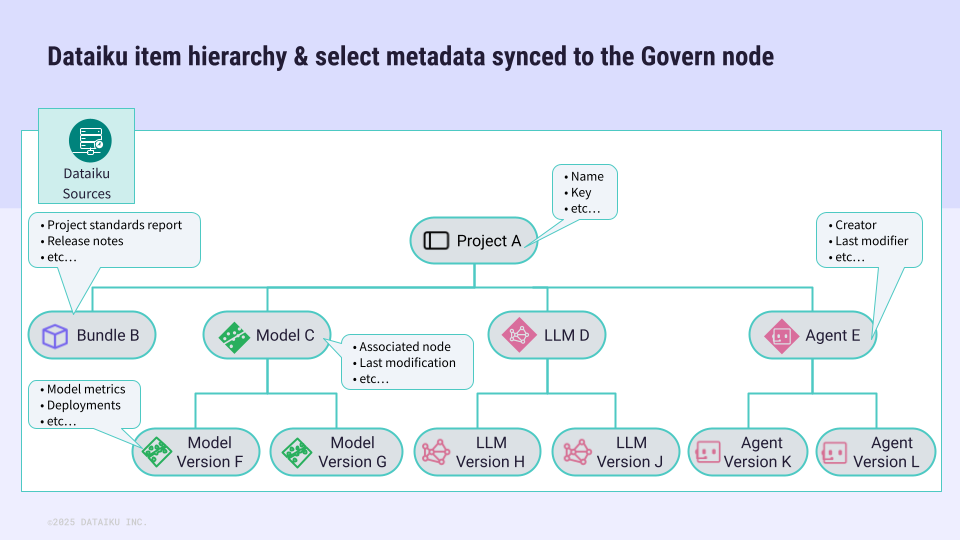
Dataiku item |
Parent-child relationships |
Diagram interpretation |
|---|---|---|
Projects |
A project is at the top of the Dataiku information hierarchy. It has no parent item. Possible child items include bundles, models, LLMs, and agents. |
Dataiku Project A is the parent of Bundle B, Model C, LLM D, and Agent E. |
Bundles |
A Dataiku project can have any number of child bundles, but a bundle belongs to exactly one parent project. |
Bundle B is a child item of its parent, Dataiku Project A. |
Saved models |
A Dataiku project can have any number of saved models, but a saved model belongs to exactly one parent project. |
Model C is a child item of its parent, Dataiku Project A. |
Saved model versions |
A saved model can have any number of child model versions, but a model version belongs to exactly one parent model. |
Model versions F and G are child items of their parent, Model C. |
Fine-tuned LLMs |
A Dataiku project can have any number of fine-tuned LLMs, but a fine-tuned LLM belongs to exactly one parent project. |
LLM D is a child item of its parent, Dataiku Project A. |
Fine-tuned LLM versions |
A fine-tuned LLM can have any number of child LLM versions, but an LLM version belongs to exactly one parent LLM. |
LLM versions H and J are child items of their parent, LLM D. |
Agents |
A Dataiku project can have any number of agents, but an agent belongs to exactly one parent project. |
Agent E is a child item of its parent, Dataiku Project A. |
Agent versions |
An agent can have any number of child agent versions, but an agent version belongs to exactly one parent agent. |
Agent versions K and L are child items of their parent, Agent E. |
Important
Later you’ll see how the Govern node extends this hierarchy with its own items, such as Business initiatives.
Next steps#
Now that you understand the item hierarchy, see Concept | Adding a governance layer to Dataiku items to learn how to govern an item.